
Buried war crimes – Sweden supports Ukraine in investigating international crimes
June 24, 2026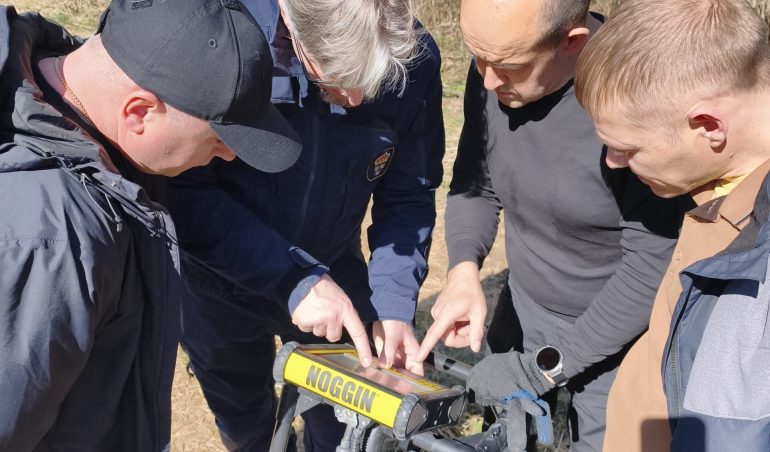
Bucha in the Kyiv region, Izium in the Kharkiv region, Lyman in the Donetsk region are just a few places in Ukraine where mass graves have been found after liberation from Russian occupation in 2022. Findings at these sites have provided important evidence for investigations into war crimes and other serious violations of international humanitarian law.
In early June, the European Union Advisory Mission (EUAM) Ukraine supported the Swedish National Police in donating radar equipment to the National Police of Ukraine. The highly specialised equipment increases Ukraine’s capacity to find and collect evidence linked to international crimes.
Finding buried bodies is a complex task which requires specialised equipment. The ground-penetrating radar Noggin can help locate objects beneath the ground, such as potential mass graves. Comparable to luggage scanners used at airports, the equipment detects different objects. But instead of showing the inside of luggage, it can see underground through stones, sand, soil and mud to find buried objects which can include bodies and body parts.
“Supporting the Ukrainian Police and its enhancement of technical capabilities and competencies in the field of forensic is a shared goal of Sweden and EUAM Ukraine,” said Åse Jansson, from the Swedish National Police and responsible for the donation and training programme, while in Ukraine to donate the equipment.
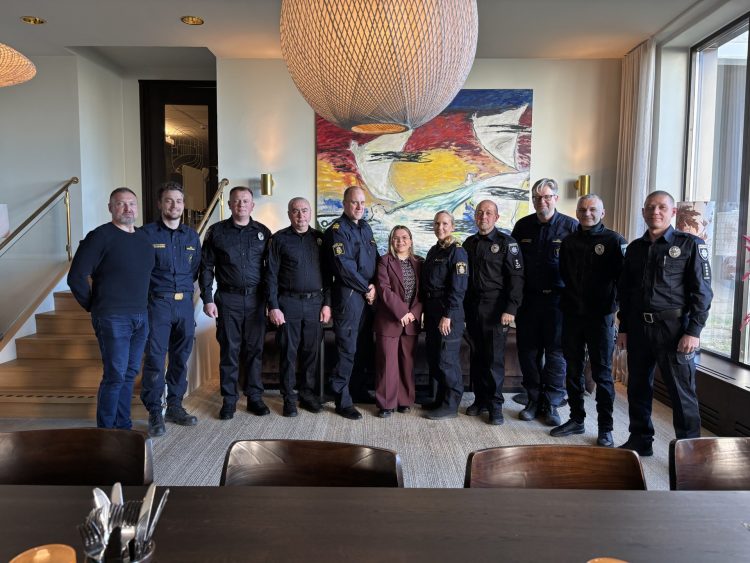
The donation strengthens the capability of the forensic department of the Ukrainian National Police. Noggin has proven operational in Sweden, and the equipment will provide an additional tool to work across Ukraine. It will be used primarily to collect evidence for investigations into alleged war crimes and other serious violations of international humanitarian law in areas affected by Russia’s war of aggression.
Comparable to images produced by an ultrasound or an X-ray machine, the radar shows contrasts and shades of the underground. The search usually starts with intelligence or information about things being hidden in the soil or buried in the ground. Noggin is then used to do detailed searches in specific areas, and pictures are taken from above the ground.
Perhaps the most important part of the work is analysing the pictures. The analysis is done by Ukrainian specialists trained in Sweden. The Ukrainian team – all with a background of forensic expertise – were trained both on theoretical preparations and practical use of the equipment in Sweden during two days in April.
An interpreter from EUAM Ukraine was present in Sweden as part of the team of instructors to facilitate training and exchange between the police forces of the two countries.
“On this journey towards a final handover of the equipment, coordination between Swedish National Police, Ukrainian National Police and EUAM Ukraine has been important and also a proof of our joint effort,” Måns Jennehag, EUAM Ukraine Adviser on General Policing, concludes.
