

Preventing Conflict Means Preserving Humanity in Difficult Circumstances
March 11, 2026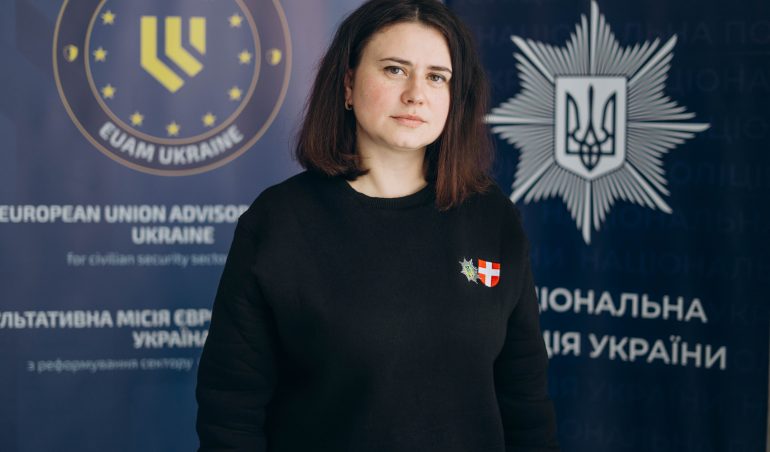
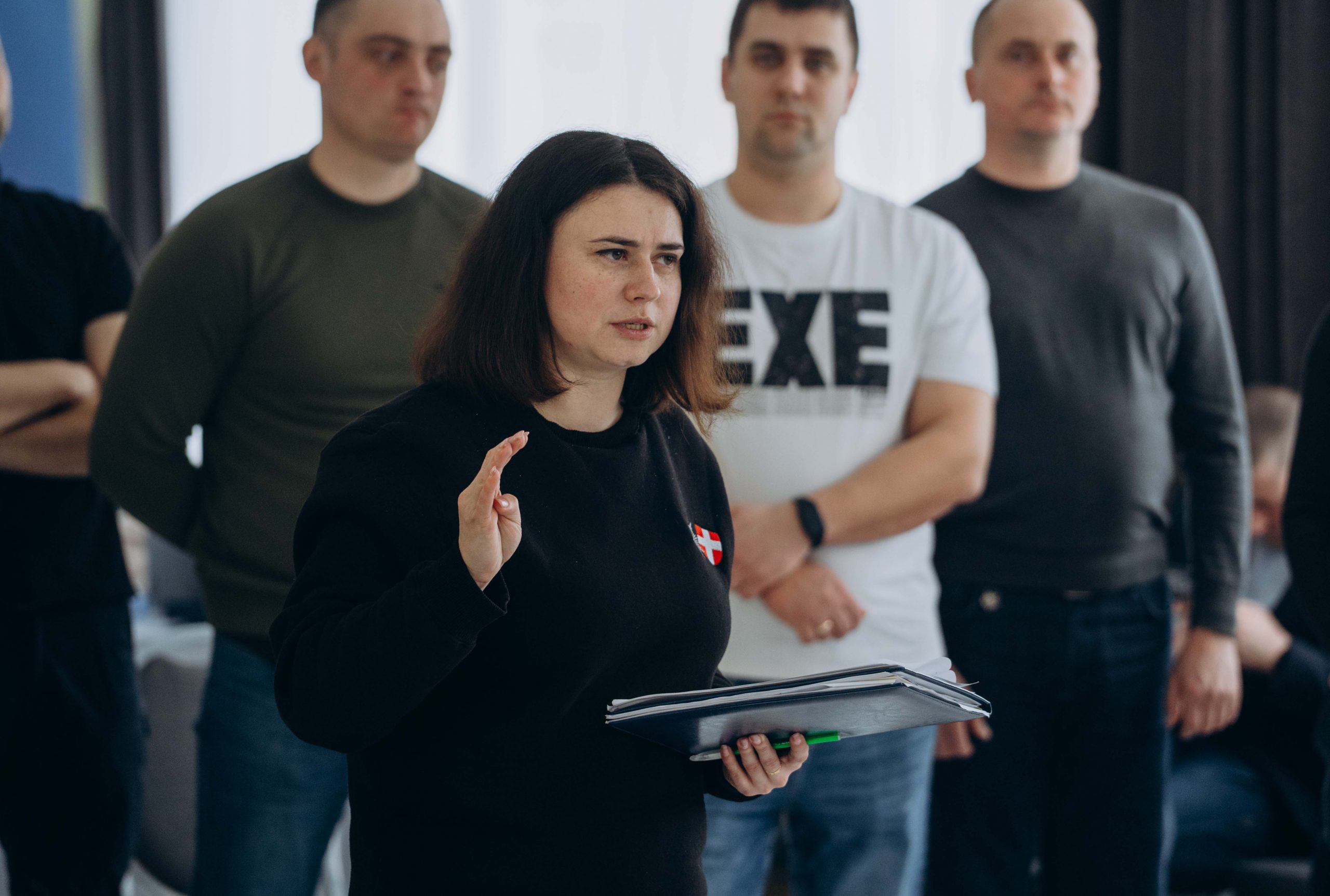
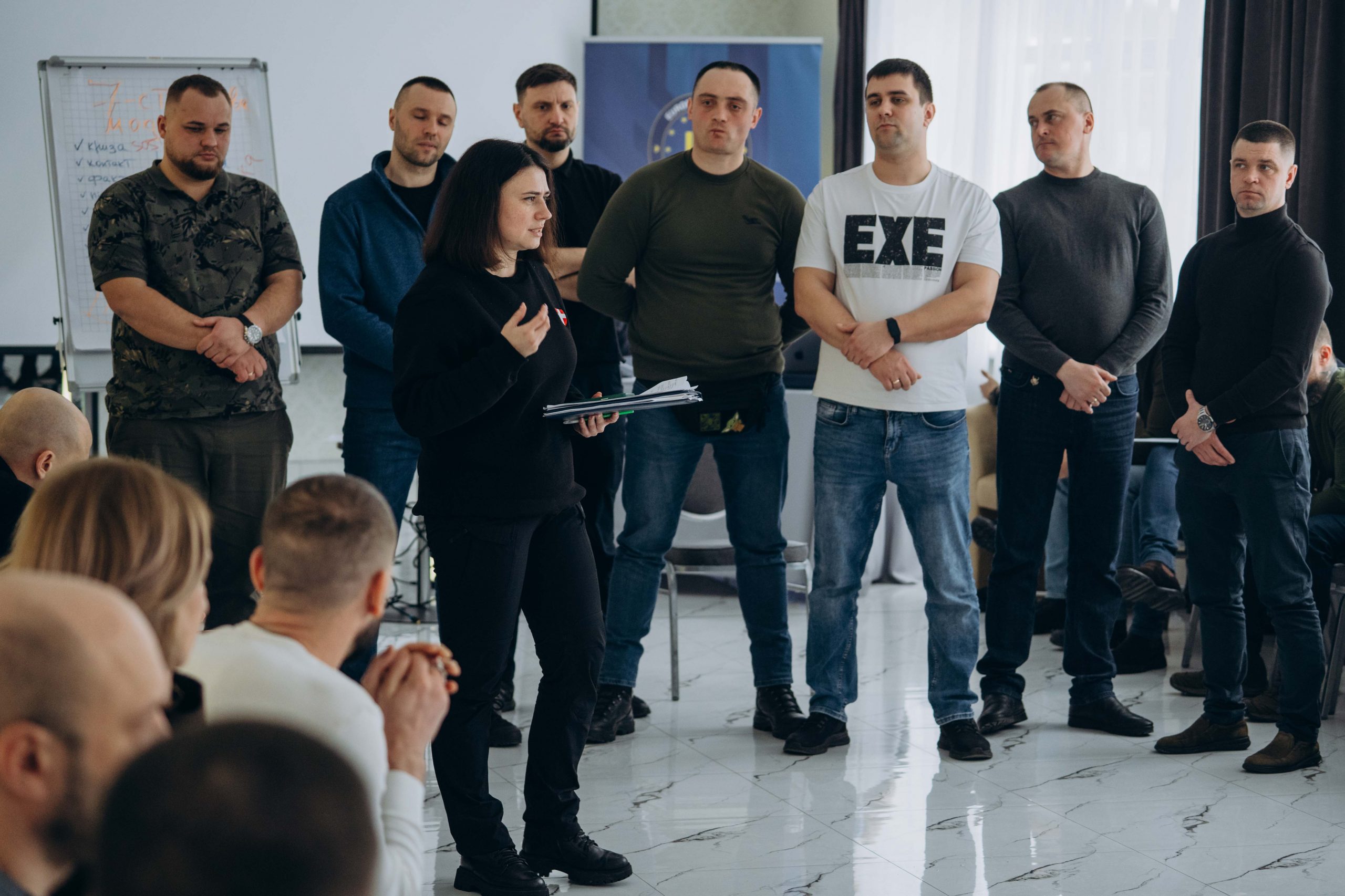
“When you see a person and engage with him or her, you do not know what is happening inside him or her,” says Olha Ostapchuk during the closing session of a crisis communication training for police officers organised by the European Union Advisory Mission in Ukraine (EUAM) together with the National Police of Ukraine in late February.
In the room are dozens of police officers from across the country. Most of them work in communities, responding to conflicts, domestic violence calls, and speaking with people who have just survived shelling or lost loved ones. Each of them knows that sometimes a single wrong phrase can make a situation worse.
“Perhaps that person has just received a message that a fellow soldier has been killed. Perhaps another tragedy has happened to them. They may be in a very unstable emotional state. That is why it is very important for you to react correctly and not provoke a conflict where it could be prevented,” Ostapchuk continues.
She speaks not as an outside observer. Olha herself is a veteran of the full-scale war and a retired major of the medical service. Today she works as a leading adviser on veterans’ policy at the National Police in Volyn region and heads the mental health centre Povernennia (“Return”) in Lutsk.
Her words immediately resonate in the room. Many of those present know what it means to receive difficult news from the front line or from colleagues in service and still continue doing their job.
It is precisely for such situations that crisis communication trainings are conducted. In today’s Ukraine, police officers increasingly deal not only with offences but also with human trauma — exhaustion, loss, the aftermath of shelling, and pain.
The war has also changed the work of law enforcement. Police officers, like the rest of society, are living through the war themselves. At the same time, they must remain the ones who help others cope with its consequences: to calm people down, explain situations, and stop conflicts that may arise from emotional exhaustion.
Preventing Conflict Before It Even Begins
Olha Ostapchuk understands this reality well. After serving in the war, she now works with veterans and sees every day how combat experience continues to shape people’s lives long after they return to civilian life.
“Conflicts often seem to arise out of nowhere. But behind them lie accumulated exhaustion, traumatic experiences and anxiety. That is why we need tools that help reduce tension before it turns into open confrontation,” she explains.
According to Ostapchuk, such training is needed not only for police officers but, in many ways, for society as a whole — to better understand both we and those returning from the front line.
“Returning to civilian life, or continuing service after combat experience, is a complex process. A person may be professionally prepared yet still remain in a state of internal tension. Training like this helps people better understand both their own reactions and the reactions of others,” she says.
The main goal of the training is to teach participants how to prevent conflicts before they escalate into open confrontation.
“We work to ensure that participants can recognise the signs of escalation in time, reduce it and change the course of events. In the best case, it means making sure the conflict does not arise at all.”
These skills are not limited to professional settings. They are equally relevant in everyday life – in communication with family members, colleagues and citizens.
“The overall level of tension in the country remains high. People are tired, many have experienced loss or trauma. In such conditions, any interaction can become a trigger. Preventing conflict means preserving humanity in difficult circumstances,” Ostapchuk concludes.










“Words Are a Police Officer’s Most Important Tool Today”
One of the programme’s trainers is Olena Demianyk, a police lieutenant colonel and Head of the Psychological Support Department at the Main Directorate of the National Police in Poltava region.
For many years, she has been working on psychological support for police officers and their families. Olena shared her experience of supporting officers and spoke about the programme itself.
“A constant background of stress, heightened anxiety for loved ones and responsibility for other people – all of this accumulates,” Demianyk says.
This is further compounded by a significant increase in crisis situations.
“Police officers work with demobilised veterans, respond to cases of domestic violence and communicate with people who have survived shelling and lost their homes, and often their relatives as well. The workload has increased, while personal resilience, unfortunately, has diminished,” she explains.
This is why crisis communication has become not just an additional skill but an essential tool of police work.
“Crisis communication is a tool that allows complex situations to be resolved through words. We teach that situations can be managed not only through the use of force. Today, words are a police officer’s main instrument,” Demianyk emphasises.
During the training, participants also learn self-regulation techniques that help them remain composed in stressful situations.
“When a person understands their emotional states and can recognise and control them, it directly affects the quality of their service,” she says.
Among the practical tools are autogenic training, grounding techniques and breathing exercises.
“These are short phrases that help stabilise a person’s state, such as ‘my body is relaxed’ or ‘I feel calm’. It is the ability to return to the present moment and feel your body. Breathing techniques allow you to calm down quickly, refocus and make balanced decisions. These are simple tools, but they work in real situations,” Olena Demianyk explains.
She acknowledges that it is not easy for police officers to talk about their own vulnerability. But, according to her, this is where the principle of “peer-to-peer” becomes particularly important.
“I am a police officer myself. I am a mother, a wife, a woman. I work in the same conditions as my colleagues. And I always stress that recognising when your resources are running out is normal. It is the first step towards helping yourself and preventing burnout,” she says.
Over 15 years of working with police officers, Demianyk has become convinced that people respond to respect, sincerity and professional support.
“When you speak with respect and genuinely believe you can help, people feel it. And even if we manage to improve someone’s quality of life by just one per cent, that is already a result,” she adds.
Demianyk also emphasises the importance of the programme itself.
“Scaling up knowledge is crucial for me. Participants come from different parts of the country and return to their units with new skills that are particularly important today,” she notes.
Moreover, she says that such training provides police officers not only with knowledge but also with an opportunity to recover. “Participants gain both theoretical and practical knowledge while also having a chance to restore their own resources. This improves how effectively they absorb the material.”
The programme has now moved into its next stage of expansion.
“We conducted three full two-week training sessions in October and November last year. Now we are running a trainers’ workshop. Participants who have already become trainers share their experience of conducting sessions in their regions. As experts, we provide mentoring support and practical advice. Each of them combines training with their regular duties, so it is important that they are not left alone with the challenges,” she explains.
Today, Demianyk adds, the community already includes 68 police trainers. If each of them works with at least one group of around 20 participants, the knowledge will reach more than a thousand police officers.
“Our goal is to have trained specialists in every region and district of the country. Then support will become systemic – not occasional, but available where it is most needed,” Olena Demianyk concludes.
